Raising a multilingual child is often seen as something only native speakers or fluent parents can do. But what if you want to introduce a language you don’t speak yourself? Is it even possible?
The answer is yes—but it takes strategy, consistency, and a clear understanding of your goals. In this post, I’ll share my personal experience of introducing multiple languages to my child, including those I’m fluent in (English and Russian) and those I’m learning and re-learning alongside him (Spanish, Japanese, and Arabic). I’ll also offer practical tips for parents who want to give their child the gift of an additional language, even if they don’t speak it themselves.
Our Story: How We Started with Multilingualism
Out of the five languages I’m introducing to my child, two come naturally: Russian, my native language, and English, which I’ve been immersed in for over 20 years. These two are the foundation of our daily life, and I’ve supported his learning by ensuring he has access to both spoken and written forms from an early age.
We started teaching him to read in English first, using the whole word reading method, and then added Russian. But at around 15 months, I decided to introduce Spanish—despite not being conversational in it myself.
Why Spanish?
- It’s widely spoken in the country we live in.
- There are Spanish immersion schools nearby.
- The alphabet is the same as English, making reading instruction easier.
We began with simple vocabulary, using whatever flashcards I could find, and later the whole word-reading method. I purchased reading materials from the Doman International program and later added picture-word cards for context. This helped tremendously—at first, he wasn’t engaged with just words, but once they were paired with images, he started recognizing and responding to them.
Later I expanded the collection of words and created phrase books and story books to help us learn.
To further support Spanish exposure, I sought out bilingual books, attended Spanish storytimes, and even hired a tutor for play-based lessons. However, I quickly realized that at 18 months, he learned best from me—even though I wasn’t fluent. So instead of relying on structured classes, I took control of our learning journey by:
- Finding books and reading materials to build vocabulary.
- Watching Spanish cartoons of shows he already liked.
- Introducing simple phrases into our daily routine.
- Creating games that incorporated Spanish words.
Now, at 3.5 years old, we’ve built a solid vocabulary of everyday items, adjectives, and simple verbs. While we’re not yet conversational, he can recognize and read Spanish words, attempts to use them in daily speech, and understands much of what he hears. Our comprehension has grown steadily through continued exposure to books, videos, and play.
Introducing Japanese and Arabic: A Different Approach
With Spanish, we had the advantage of similar alphabetic systems and some degree of real-world exposure. But what about languages that are completely different from English and Russian?
I had previously studied Japanese and Arabic, though it had been over 20 years. Still, I wanted my child to be exposed to these languages early on, especially their writing systems.
Japanese: Recognizing Patterns
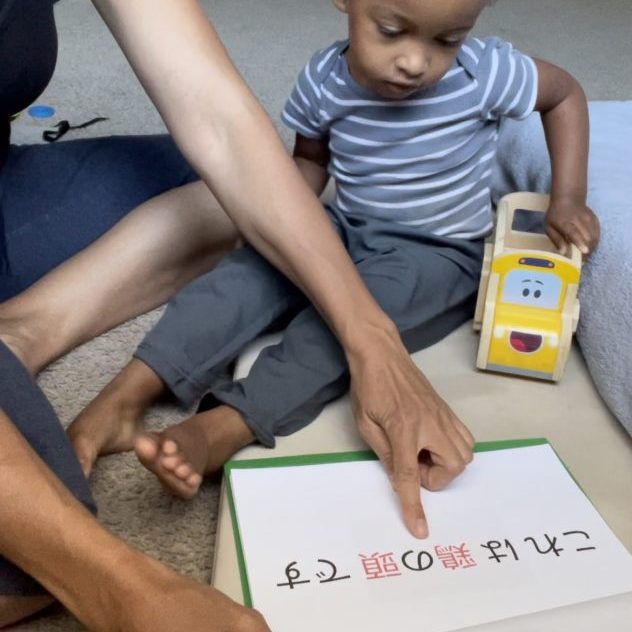
Japanese has a complex writing system, with two alphabets (hiragana and katakana) and kanji (Chinese-derived characters). Instead of waiting until later, I decided to expose my child to all three right away with whatever materials I could find.
Later we started using picture-word cards that I designed for my store, but now in Japanese.
Some key strategies I used:
- Flashcards with words and pictures to build familiarity.
- Cartoons and educational videos introducing simple words.
- Basic sentence structures to model how phrases change.
The real breakthrough came when he naturally picked up grammar patterns just from exposure. One day, he saw a flashcard with the word omoshiroi (interesting) and made a full sentence in Japanese, saying whether or not he liked a show. This moment proved to me that even with minimal exposure, consistent input leads to recognition and eventual speech attempts.
Arabic: Exposure to a Completely New Script
Unlike Japanese, I had forgotten most of my Arabic—but I still wanted to introduce the writing system. Arabic is written right to left and has a script that looks nothing like English, Russian, or Japanese.
My goal was simple: exposure to the Arabic alphabet so that, in the future, learning the language would feel familiar rather than foreign. To do this, I:
- Found phonetic videos and songs for early exposure.
- Used picture-word flashcards to introduce words.
- Played basic Arabic speech videos to normalize the sound.
At this stage, my son knows basic Arabic greetings and recognizes a few words, which is exactly what I hoped for. Even if we don’t reach fluency, early exposure lays a foundation for future learning.
Can You Teach a Language You Don’t Speak? Yes, If You Have the Right Strategy
If you’re considering introducing a new language to your child, here’s what I recommend:
1. Define Your Goal
- Do you want fluency, basic communication skills, or just exposure?
- Are you willing to learn alongside your child, or do you need outside help?
2. Use Reading as an Anchor
- Teaching your child to read early in the target language gives them an independent tool for learning.
- The whole word reading method is great for early literacy in any language.
3. Surround Your Child with the Language
- Books, music, and videos create passive exposure.
- Bilingual storytimes, tutors, or language groups help reinforce learning.
4. Find Ways to Introduce Speech Naturally
- Use phrases in daily routines (e.g., counting, colors, food names).
- Play language-based games (e.g., “Find something red” in the target language).
- Expose them to native speech through media and conversation partners.
5. Adjust Your Expectations
- If you’re not fluent, your child won’t become fluent overnight—but they will develop an ear for the language.
- Even limited exposure builds a foundation for future learning.
- Consistency is more important than speed.
Want More Strategies? Join My Multilingual Development Webinar!
In my multilingual development webinar, I dive deeper into how to introduce multiple languages, even if you don’t speak them fluently. I share:
✅ How to create an immersion-like experience at home
✅ Ways to teach reading in multiple languages
✅ Strategies for balancing multiple languages without overwhelm
✅ How to set realistic expectations based on your child’s environment
If you’re serious about raising a multilingual child and want practical, real-world strategies, this is for you!
Final Thoughts
You don’t have to be fluent to introduce a new language to your child. You just need commitment, creativity, and a structured approach. Whether your goal is fluency or just exposure, starting early will make future language learning easier and more natural.
If you’ve tried introducing a new language to your child, let me know in the comments—what worked for you? What challenges have you faced? Let’s learn from each other!

