
Math for babies? Absolutely! While most adults break into a sweat at the thought of teaching math, babies are actually wired to understand quantity in a way we can’t. Thanks to their right-brain dominance in early life, they can instantly recognize large quantities without counting—an ability known as “subitizing.” So instead of teaching them to count, we help them see numbers in action. (based on Glenn Doman’s book “How to teach your baby math”)
Step 1: Quantity Recognition (Days 1-10)
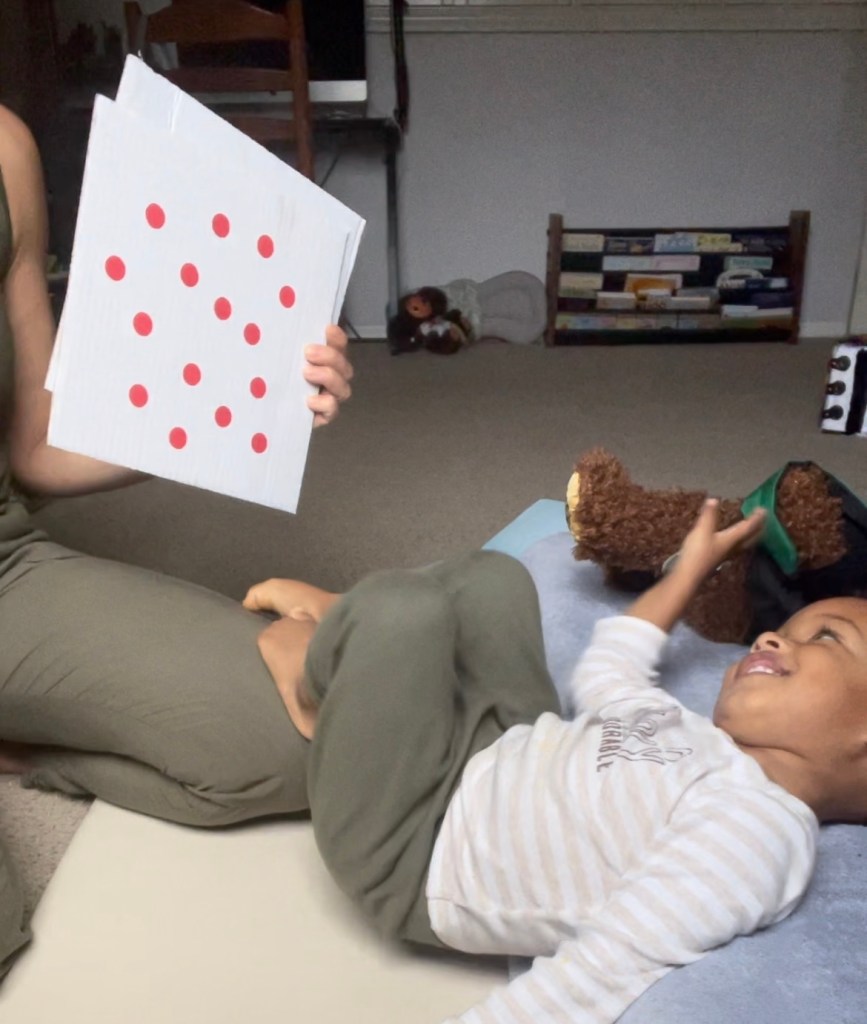
We start simple. For the first five days, we introduce numbers 1 to 10 using dot cards. Sessions are quick—just flash 5 shuffled cards per session, six times a day, with at least 30 minutes between.
On Day 6, we begin a rotation:
• Remove the two lowest numbers
• Add the next two higher numbers
By Day 10, your child has seen quantities up to 20—all without counting. Now, it’s time for the real fun: equations!
Step 2: Addition & Beyond (Days 11-50)
Starting on Day 11, we sneak in three simple addition problems per session, three times a day. Now, the program consists of nine daily sessions: six with quantity cards and three with equations.
From here, we follow the same structure:
• Days 11-20: Addition (1-20)
• Days 21-30: Subtraction (1-40)
• Days 31-40: Multiplication (1-60)
• Days 41-50: Division (1-80)
And just like that, your baby is doing math most adults would hesitate to attempt in their heads!
Life Happens—And That’s Okay
Let’s be real: following the program perfectly is nearly impossible. But don’t stress! Glenn Doman himself reassures us:
“No matter how poorly you expose your baby to mathematics, he is almost sure to learn more than he would if you hadn’t done it.”
In other words, even if you’re juggling naps, laundry, and snack negotiations, your baby is still learning. Just do your best, keep it fun, and keep going.
Step 3: Problem-Solving & Patterns

Doman encourages parents to avoid testing—after all, learning should be exciting, not stressful! But if you’re curious to see what your little one knows, you can turn it into a game:
• At the end of a session, hold up two cards and casually ask, “Where’s 52?”
• If they get it right, celebrate! If not, simply say, “This is 52, and this is 37,” and move on. No pressure, just exposure.
As the program progresses, you can introduce:
✅ Sequences
✅ Greater than / Less than
✅ Equalities & Inequalities
✅ Fractions
✅ Simple Algebra
And all of this? Still with dot cards—because at this stage, we want your baby to see real quantities, not just symbols.
Step 4: Moving to Numerals
After the division phase, we swap out dot cards for numerals. The process is familiar:
• Start with two sets of numbers (1-10)
• Each session has five shuffled cards
• Every five days, remove the lowest numbers and add higher ones
• Once we reach 20, we introduce a bridging step—matching dots to numerals
At this stage, we also start using symbols for equalities, inequalities, and comparisons:
• 17 dots = 17
• 5 > 2 dots
• 6 < 15 dots
From here, it’s a repeat of everything we’ve done before—but now with numerals! Addition, subtraction, multiplication, division, sequences, fractions… all the good stuff, but now in written form.
By the end of the program, you can write full equations on a strip of paper, invite your child to create their own, and even gradually shrink the font size for more complex equations.
And Finally… The Magic of Zero
Once your child understands quantity, something incredible happens: they recognize that sometimes, there is no quantity. Introducing the zero card is always a hit—because suddenly, everything clicks.
Ready to Start?
You don’t have to figure this all out on your own! Our Math Program with Cards gives you everything you need to follow the program with ease. Even better? It’s part of the Starter Bundle, which lays out the entire Early Education approach and includes the Reading Program.
Let’s make early learning simple, stress-free, and—most importantly—fun! Grab your Starter Bundle today and watch your little one’s love for learning take off.

